
GG777 Color Game vs Tongits: Which Faster? is a question often asked by players who care about game pace, round duration, and how quickly outcomes are decided. Speed affects not only how long a session lasts, but also how intense, demanding, or relaxed the experience feels. While both games are popular, they are built on completely different design philosophies.
Game Structure Comparison in GG777 Color Game vs Tongits: Which Faster?
The structure of a game determines how quickly players move from one result to the next. In GG777 Color Game vs Tongits this difference is immediately visible.
Round Definition in GG777 Color Game vs Tongits: Which Faster?
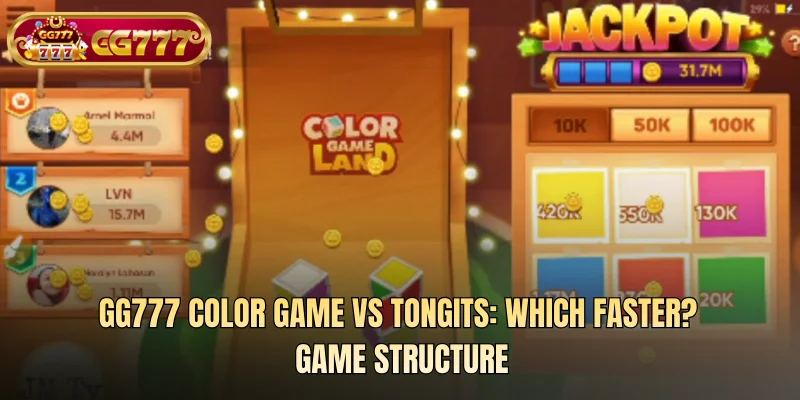
In the GG777 Color Game, a round is extremely short. Players place a bet, wait for a brief countdown, and see the result almost instantly. Once the result appears, the next round begins without delay. This creates a loop where dozens of rounds can occur in just a few minutes.
Tongits defines a round as a full hand of cards. Each hand involves dealing, multiple player turns, and a clear ending condition. Even in fast tables, a single round takes significantly longer than a color game cycle. From a structural perspective, this already answers part of GG777 Color Game vs Tongits.
Reset Speed Between Rounds
Reset speed plays a major role in perceived pace. The GG777 Color Game resets immediately after each result. There is no downtime, no reshuffling, and no waiting for other players’ decisions.
Tongits requires a reset after each hand. Cards are reshuffled, players reassess positions, and a new hand begins. This natural pause slows the overall tempo and makes sessions feel longer even when fewer rounds are played.
Impact of Structure on Player Rhythm
Because of its structure, the color game creates a continuous rhythm with almost no interruption. Tongits creates a segmented rhythm where focus builds during a hand and releases at the end. In GG777 Color Game vs Tongits, continuous rhythm clearly favors speed.
Decision Flow Analysis in GG777 Color Game vs Tongits
Decision flow determines how much thinking and waiting occurs before a result is locked in. This is another critical dimension of GG777 Color Game vs Tongits: Which Faster?.
Number of Decisions Per Round
The GG777 Color Game requires only one decision per round: selecting a color or option and placing a stake. Once that decision is made, the player waits passively for the outcome.
Tongits requires repeated decisions within a single round. Players must decide which card to draw, which to discard, whether to form melds, and when to call a win. Each of these decisions adds time and complexity.
Waiting Time Caused by Other Players
In the color game, players are never blocked by others. All participants act simultaneously within the same short betting window.
In Tongits, players must wait for others to take turns. Even if one player is quick, the pace is dictated by the slowest decision-maker at the table. This waiting time is unavoidable and directly affects speed in GG777 Color Game vs Tongits
Mental Load and Its Effect on Speed
Lower mental load leads to faster gameplay. The GG777 Color Game keeps mental effort minimal, allowing rapid repetition. Tongits demands sustained attention and calculation, which naturally slows play but increases strategic depth.
Outcome Frequency and Session Pace in GG777 Color Game vs Tongits
Outcome frequency strongly shapes how fast a game feels during a session. This is often the deciding factor for players asking GG777 Color Game vs Tongits: Which Faster?.
How Often Results Appear
In the GG777 Color Game, results appear every few seconds. Win or lose, the player receives immediate feedback. This high-frequency outcome cycle makes time feel compressed and sessions feel fast.
Tongits produces outcomes only at the end of each hand. A player may spend several minutes playing without seeing a definitive win or loss. This lower outcome frequency slows perceived pace.
Session Length and Perceived Time
Because results are frequent, GG777 Color Game sessions often feel shorter than they actually are. Players may complete many rounds in a short time without noticing the passage of time.
Tongits sessions feel longer because each hand is a self-contained process. Even if total playtime is similar, the slower rhythm makes time more noticeable. That’s why players often perceive Tongits as more “time-consuming” even when the clock says otherwise. With fewer rapid-fire moments, each decision stretches the pacing and makes the session feel heavier.
Player Fatigue and Speed Sustainability
Fast games can cause quicker fatigue due to constant action. The GG777 Color Game is fast but intense. Tongits spaces decisions out, allowing mental recovery between actions. In GG777 Color Game vs Tongits: Which Faster?, speed favors the color game, but sustainability may favor Tongits for longer sessions.
Strategic Depth vs Raw Speed in GG777 Color Game vs Tongits
This trade-off is central to GG777 Color Game vs Tongits: Which Faster? The color game prioritizes immediacy. Strategy is limited, and outcomes depend largely on probability. This design maximizes speed and minimizes friction.
Tongits sacrifices speed for depth. Each hand allows players to influence outcomes through skill, observation, and timing. While slower, it provides a richer experience for those who value strategy.
Final Verdict on GG777 Color Game vs Tongits
From a mechanical and experiential standpoint, GG777 Color Game vs Tongits: Which Faster? has a clear answer. The GG777 Color Game is faster in:
- Round duration
- Decision speed
- Outcome frequency
- Session intensity
Tongits is slower but offers:
- Strategic depth
- Player interaction
- Turn-based control
Conclusion
GG777 Color Game vs Tongits: Which Faster? ultimately depends on what a player values. If speed means rapid results, minimal waiting, and continuous action, the GG777 Color Game is unquestionably faster. Its structure is built for instant play and quick resolution. If speed is secondary to strategy and interaction, Tongits offers a slower but more thoughtful experience.